
The last five blog posts have concentrated on strategy, clarity, alignment, and fundraising tactics.
Stop Chasing Donations
How to Build a Nonprofit that Attracts Donations Instead
I thought we’d continue with the notion that “more fundraising can’t fix fundraising.” And we’ll hear more from Kevin L. Brown, CEO of Might Ally.
I follow Kevin closely on LinkedIn and use his book, Fundable & Findable, as a daily resource. The insights for this blog post come from one of his recent YouTube videos. I hope you enjoy this guidance.
------
If your nonprofit is struggling to reach its next funding milestone, the solution might not be more fundraising.
According to Kevin L. Brown, CEO of Mighty Ally and author of Fundable & Findable, the problem often lies in a "brand gap" that leaves organizations unseen, unheard, and underfunded.
In a recent episode of The Social Impact Journal, Kevin shared his breakthrough Fundable & Findable framework. This strategy shifts the focus from chasing every donor to building a brand that naturally attracts them.
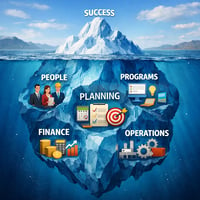
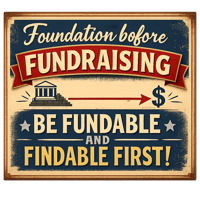
The ultimate path to transform your organization and its growth is to become fundable first and findable second.
------
The Paradox: Why More Fundraising Can’t Fix Your Fundraising
Most nonprofit leaders believe that if they just had a better pitch deck or a larger email list, their funding problems would vanish. Kevin argues the opposite: Fundraising alone can’t fix your fundraising.
He compares it to a starving person trying to cook more - you can’t cook without the ingredients.
In the social sector, those "ingredients" are a clear Theory of Change and a Strategic Plan. Without them, you are simply adding noise to a crowded market.
Phase 1: Be Fundable (The Internal Work)
Being "fundable" is about getting your internal house in order so that a donor feels confident investing in you. This involves two critical components:
1. The Theory of Change (Your "Product")
In the private sector, companies sell products. In the nonprofit sector, your Theory of Change is your product. It’s the logical map of how your activities lead to specific, measurable outcomes.
- The Need: What specific problem are you solving, and for whom?
- The Work: What are your unique interventions and big ideas?
- The Results: What impact are you holding yourself accountable for?
2. Strategic Planning
A strategic plan shouldn't be a 50-page document that sits on a shelf. Kevin advocates for an agile approach:
- A 10 to 25-year vision: Where are you going?
- 90-day "Rocks:” What are the immediate priorities your team must hit?
- The Right People: As the saying goes, "First who, then what." Ensure your team is in the right seats to execute the mission.
Phase 2: Be Findable (The External Work)
Once you are fundable, you need to be "findable." This is where marketing and branding come into play.
3. Positioning Strategy
Good positioning is the intersection of:
- What your organization is great at.
- What funders are willing to support.
- What other organizations aren’t doing.
To stand out, you must have the courage to say "no" to certain opportunities and remain focused on your "secret sauce."
4. Marketing Communications
This is about telling your story with clarity and consistency. Kevin emphasizes:
- Messaging Architecture: Have a "script" that everyone from the board to the staff uses.
- Outcomes over Outputs: Don’t just report how many people attended a workshop (outputs); tell the story of how their lives changed (outcomes).
- Visual Identity: Your logo and design should reflect your brand's personality, whether that is "The Hero," "The Sage," or "The Innocent."
Key Takeaways for Nonprofit Leaders
Brand First, Funding Second: Invest in your strategy and clarity before launching your next campaign.
- Mission Clarity is King: The number one complaint from donors is that they simply don't understand what a nonprofit does. Keep it simple.
- Resilience is the Solution: In times of crisis, organizations with a strong, clear brand are the ones that survive and scale.
Final Thoughts
The journey from being "underfunded" to "scalable" requires a mindset shift. By applying the Fundable & Findable framework, you stop being a "nonprofit" and start being a "for-purpose" social impact organization that donors are eager to partner with.
Ready to dive deeper?
Check out Kevin L. Brown’s book, Fundable & Findable, or visit Mighty Ally for tools and templates to help your organization grow.
Or if you’d like to have a conversation about how you might optimize your enterprise to drive revenue, click here.